Islam in Europe by Jack Goody
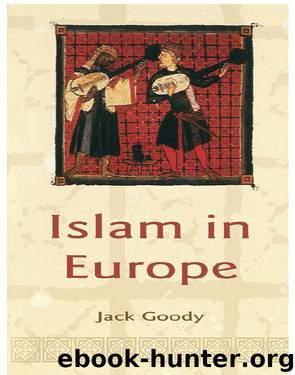
Author:Jack Goody
Language: eng
Format: epub
Publisher: Wiley
Values
The East in its various forms continues to be seen as very different from the West in its ‘despotic’, anti-democratic governments, the absence of freedom and of the Christian concepts of love and charity (caritas). Indeed a number of countries have drawn a veil over past contacts with Islam, partly because of the perceived discrepancy in value systems. Here I want to call attention to the many convergences that enabled the different communities to interact peacefully as well as conflictually. The point about charity is simplest to deal with, since it was a duty of Muslims to give to the poor, and many charitable bequests (waqf) were established which provided educational, hospital and other social facilities. The notions of love and freedom I shall consider, with particular reference to the studies of Nur Yalman (2001]. Regardingthe nature of government; it is all too easy to note the arbitrary features of the monarchical and republican regimes of the present Near East, and to ignore the authoritarian regimes of Europe in the not-too-distant past, including the extraordinary efforts of Queen Victoria to install her offspring on the thrones of all the major European powers. Regarding democracy, there is more than one way of consulting the people, in addition to the numerical head counts that are part of the modernizing ‘ideology’ of the recent West. And it is as well to reckon with the limitations of such methods when we take into account the minority that gave the present president power in the USA, and the way that even the head of the elected government in Britain can threaten a major war without the authority of parliament or the UN Security Council and against the opinion of a majority of the electors. Other systems of consultation would make that impossible. We ourselves prefer frequent elections and changes of government; but we need to recognize the limitations of any system of authority, whether Western or Eastern. Some measure of consultation takes place in virtually all regimes.
It will help to give more substance to this comparison if we turn to the views of Islam on equality, fraternity and freedom, so often seen as markers of the liberal democracies of the West. Writing of equality and love (which in this context is fraternity), Yalman sees these as a ‘fundamental aspect of the culture of Islam’. Certainly they are ‘translated’ into practice in the notion of open access of opportunities for people and of the absence of a group with privileged access to divine truths. That idea has been one of the great appeals of the faith to underprivileged groups such as the Black Muslims in the United States. But that notion does not mean there is no inequality among Islamic peoples. ‘In practice, inferiority and superiority are as much a part of daily Islamic experience as any other’ (Yalman 2001: 271).
Yalman contrasts these high ideals with the notions of hierarchy and renunciation seen by Dumont (1970) as being fundamental to India, counterpoising the highly idealizedformula of Islam on the one hand and that of India on the other.
Download
This site does not store any files on its server. We only index and link to content provided by other sites. Please contact the content providers to delete copyright contents if any and email us, we'll remove relevant links or contents immediately.
| Anthropology | Archaeology |
| Philosophy | Politics & Government |
| Social Sciences | Sociology |
| Women's Studies |
The Secret History by Donna Tartt(19089)
The Social Justice Warrior Handbook by Lisa De Pasquale(12190)
Thirteen Reasons Why by Jay Asher(8910)
This Is How You Lose Her by Junot Diaz(6887)
Weapons of Math Destruction by Cathy O'Neil(6281)
Zero to One by Peter Thiel(5802)
Beartown by Fredrik Backman(5754)
The Myth of the Strong Leader by Archie Brown(5508)
The Fire Next Time by James Baldwin(5446)
How Democracies Die by Steven Levitsky & Daniel Ziblatt(5219)
Promise Me, Dad by Joe Biden(5153)
Stone's Rules by Roger Stone(5088)
A Higher Loyalty: Truth, Lies, and Leadership by James Comey(4964)
100 Deadly Skills by Clint Emerson(4925)
Rise and Kill First by Ronen Bergman(4789)
Secrecy World by Jake Bernstein(4753)
The David Icke Guide to the Global Conspiracy (and how to end it) by David Icke(4720)
The Farm by Tom Rob Smith(4513)
The Doomsday Machine by Daniel Ellsberg(4490)
